
 1 hour ago
7
1 hour ago
7
ARTICLE AD BOX
Sarah RainsfordSouthern and Eastern Europe correspondent, Rome

 Reuters
Giorgia Meloni said the vote was a missed chance to modernise Italy
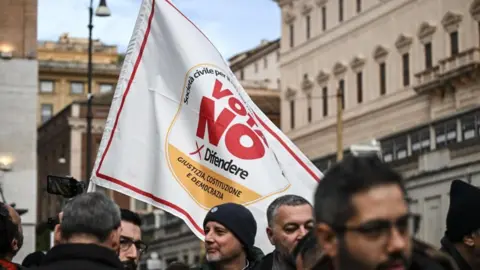
Italy's Prime Minister Giorgia Meloni has lost a key referendum on a constitutional reform which had turned into a vote on her government.
The result gives around 54% to the "No" campaign and 46% to the "Yes" vote which Meloni had backed.
In a video posted on social media even before all the ballots were counted, Meloni said Italians had voted "with clarity" and she would respect their decision, but she regretted a "lost chance to modernise" the country.
It is the first significant defeat for Meloni and her right-wing coalition, which has overseen a rare period of political stability for Italy. Opposition parties are hailing the result as a sign that voters are looking for change, with a general election due next year.
When the two-day referendum ended on Monday afternoon, exit polls initially showed the "No" vote leading by a small margin, but that grew to a substantial lead as the count progressed.
Despite the complex question on the ballot paper, turnout was almost 60%. A high figure had been expected to favour the government, but it was not enough to swing the vote.
The reform voters rejected would have inscribed a firm separation between judges and prosecutors into the constitution. It also proposed distinct bodies to govern them and a new disciplinary court.
The government argued the change was critical to improving judicial independence.
The opposition countered that it would shatter a careful balance of powers established following the defeat of fascism, and increase political influence over the courts.
Many Italians struggled to understand the technical details - perhaps a communication failure by Team Meloni - and the vote quickly morphed into a plebiscite on her near-record three and half years in office.
 EPA
EPA
The 'No' supporters turned out to celebrate their victory
But it fell at a difficult time.
Meloni is a close ally of Donald Trump, but the US president is increasingly unpopular here, as is his war in the Middle East.
And with Italy's economy already stagnant, many people are concerned about the war's impact on their energy costs.
Meloni always ruled out stepping down, whatever the result, unlike Matteo Renzi in 2016 who called his own constitutional referendum as prime minister and lost.
"The vote is not about me, but about justice," Meloni argued ahead of this vote.
After the result became clear, Renzi counselled that her government had now lost its "magic touch" and needed to listen more closely to the voters.
"Losing and walking out whistling just isn't an option," he told Italian radio.
Had Meloni won, she would likely have felt emboldened to pursue other political ambitions, including a reform to introduce direct elections for prime minister.
Instead, the opposition Democratic Party leader Elly Schlein said Meloni's defeat showed "there is an alternative to this government" ahead of next year's general elections.
This loss has rubbed some of the shine off the coalition and Meloni herself, long the strong woman of Italian politics, has been left looking more vulnerable.







 English (US) ·