
 2 hours ago
6
2 hours ago
6
ARTICLE AD BOX
Wyre Davies and Samantha Granville,reporting from Beirutand Mallory Moench

 Reuters
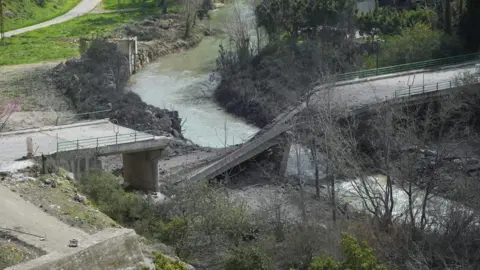
The Zrarieh Bridge over the Litani river was damaged in a strike on Friday, followed by strikes on other crossings on Wednesday
Israeli air strikes have destroyed two bridges over the Litani River linking southern Lebanon with the rest of the country, the military says.
It comes hours after the Israeli military said it would target crossings it alleged were being used by the Hezbollah armed group to move fighters and weapons.
Elsewhere, Israeli strikes hit multiple locations in Beirut, killing at least 12 people and wounding 27, Lebanese authorities said. The escalation marks a widening of Israeli strikes beyond the southern suburbs into central Beirut.
The Lebanese health ministry says that 968 people, including at least 111 children, have been killed since 2 March.
Lebanon was drawn into the US-Israel war against Iran when Iran-backed Hezbollah fired missiles into Israel. Israel responded with air strikes and later sent ground troops into southern Lebanon.
Defence minister Israel Katz said the bridges were targeted on Wednesday in a "direct action against Hezbollah's use of Lebanon's state infrastructure to advance terrorist activity". Hezbollah has not yet commented.
Earlier on Wednesday, the Israeli military warned civilians near the Litani crossings to evacuate.
On Friday, the Zrarieh Bridge over the Litani was damaged in an Israeli strike.
The Litani River has long been central to Lebanon's fragile security landscape. Under UN Security Council Resolution 1701, which ended the 2006 war between Israel and Hezbollah, armed groups are barred from operating south of the river. Israel says Hezbollah maintains a significant presence there.
The latest Israeli warnings to evacuate have deepened an already severe displacement crisis. More than a million people have been forced to leave their homes, Lebanese officials say, mainly in the south and east of the country and southern Beirut, where Hezbollah's presence is strongest.
Overnight on Wednesday, Israeli strikes also hit the town of Zefta in the Nebatieh district, south of the river.
A group of men swept shattered glass from in front one of the collapsed buildings. A 25-year-old man said the strike had come without warning, and he after hearing a loud noise he had been thrown across the room by the blast.
"There's no one here related to a political party," he said. "We are all civilians, not affiliated with anyone."
At the scene of Israeli strike in the heart of Beirut
Early on Wednesday an Israeli air strike destroyed a building in Beirut's city centre. The Israeli military had issued a warning at 04:00 local time to evacuate the building. It had already been targeted several times in recent days.
No casualties have so far been reported from the strike, which hit a few hundred metres from residential buildings and hotels.
Video showed a missile hitting the base of the multi-storey building and the structure collapsing. The area was shrouded in smoke, with debris scattered across the street and the smell of burning lingering in the air.
Bystanders stood in shock, surveying the destruction. Tensions quickly rose among onlookers. Some shouted angrily, directing blame at Israel, while a group of men raised a tall poster of Hezbollah's slain leader, Hassan Nasrallah, marching it to the top of the pile of rubble.
Israel says it is targeting not only Hezbollah fighters and leaders, but also businesses it claims are linked to the group and help finance its military operations, including the Al Qard Al Hassan organisation which has offices across the city, many of which have been blown up.
It is also continuing relentless bombardment of the Hezbollah stronghold in south Beirut known as Dahieh, forcing thousands to flee their homes and reducing parts of the city, in the words of some locals, to a scene "resembling Gaza".
But Israel is now targeting other parts of Beirut - sometimes with prior warning, on other occasions without, in what appear to be targeted assassinations including at least two strikes on hotels.
Civilians are frequently killed in these attacks. One reported Israeli "double tap" airstrike - where a location is hit twice in quick succession - on a car near Beirut's Corniche seafront last week killed at least 12 people, many of them said to be displaced civilians from elsewhere in the country who had been sheltering in tents.






 English (US) ·