
 1 hour ago
3
1 hour ago
3
ARTICLE AD BOX
Jessica MurphyCanada digital editor, Toronto

 NurPhoto via Getty Images
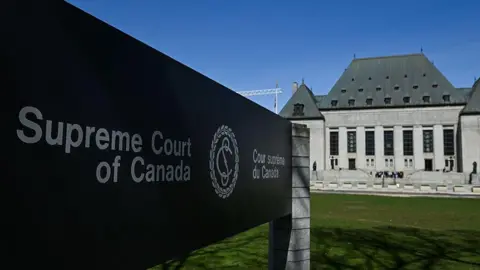
A controversial secularism law in Quebec is heading to Canada's Supreme Court - but the outcome will impact much more than religious expression in Canada, legal experts say.
The case has the potential to test national unity and the balance between courts and elected officials.
"This case is probably going to be the most important constitutional case in a generation," said Christine Van Geyn, executive director at the Canadian Constitution Foundation.
At the heart of the case is Bill 21, which bars civil servants like judges, police officers and teachers from wearing religious symbols at work. It was passed in 2019, by the governing Coalition Avenir Quebec (CAQ).
But to withstand legal challenges, legislators employed a unique Canadian invention, the controversial "notwithstanding clause". That legal loophole allows governments to override certain constitutional rights, including freedom of religion and equality rights.
The Canadian Civil Liberties Association (CCLA) called Quebec's arguments in court "spine-chilling".
"Could a government invoke [the clause] to ban abortion? To criminalise political speech critical of the government? To legalise torture?" the CCLA wrote in a recent op-ed in French-language newspaper Le Devoir.
"According to the Quebec government's logic, even in such cases, the courts would not only be powerless but also bound to silence."
On Monday, the court will begin four days of hearings on a constitutional challenge to Bill 21, with more than 50 interveners including the federal government.
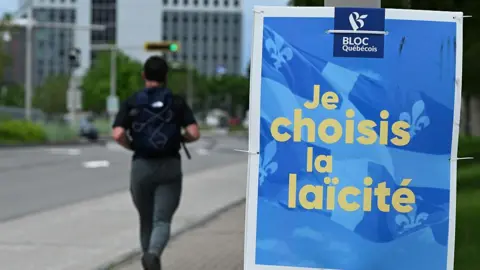
As in France, Quebec's state secularism - or laïcité - is central to its identity.
Similar to the concept of America's "separation of church and state", proponents of laïcité believe that state institutions should be religiously neutral.
But what that means in day-to-day life has become the subject of much debate.
Supporters of Bill 21 argue it's a reasonable step towards enshrining the separation of church and state in Quebec, while critics say it is discriminatory, has made it more difficult for religious minorities to integrate, and that it unfairly targets Muslim women - though the legislation does not single out any religion.
In an attempt to insulate the legislation from legal battles, the CAQ pre-emptively included the "notwithstanding clause" in the bill.
That clause is section 33 of the Canadian constitution. It allows a provincial or federal government to override certain "fundamental freedoms" of religion, expression, and association; as well as legal and equality rights.
The clause is in effect for a five-year period, which is meant to give time for voters to respond with political consequences if they disagree with the law.
It is subject to renewal, and in theory can be extended indefinitely.
 NurPhoto via Getty Images
Polls suggest that a majority of people in Quebec support Bill 21
Why does Canada have a notwithstanding clause?
In the early 1980s, Canada was seeking to repatriate its constitution from the United Kingdom and to incorporate a Charter of Rights and Freedoms, similar to the US Bill of Rights.
The clause was used as a "grand bargain" to get all the provinces on board, including some who were concerned a rights charter would give more power to courts than to democratically elected legislators.
It applies to some but not all charter rights - democratic and language rights are excluded, for example.
The notwithstanding clause was brought in as a safety valve. Although it has been used several times by Quebec over the past few decades, it has increasingly been employed by other provinces to introduce controversial legislation.
Aside from Bill 21, the clause has been invoked recently by Ontario to cut the size of Toronto's city council, by Alberta to order striking teachers back to work, and by Saskatchewan to require parental consent before students under 16 could change their names or pronouns at school.
That has led some to argue it is being used beyond the general understanding that it would only be used as a last resort.
Errol Mendes, a law professor at the University of Ottawa who is also an intervener in the case for the International Commission of Jurists Canada, said that he and others warned the clause was overly broad and could be misused.
"And our predictions were coming true now, because there slowly started to be more and more use of the clause."
This week's hearing will be the first time the Supreme Court has heard a challenge to the provision since 1988.
Watch: Quebec debates stricter rules on religion in public spaces - here's what people think
What do the opposing sides say?
The Canadian Civil Liberties Association and Ichrak Nourel Hak - a Muslim teacher in Quebec who wears a hijab - are among those who sought leave to appeal.
In a statement, they argue that in Quebec "Bill 21 has been infringing on the dignity, rights and freedoms of individuals who work in or aspire to work in the public service" and "has a disproportionate impact on specific religious minority groups, such as Muslim, Sikh and Jewish communities".
Quebec argues that whether or not the bill restricts freedoms is not the issue as it is shielded by the notwithstanding clause.
"Section 33 constitutes, in a way, one of the cornerstones of the Canadian Charter," Quebec argues in legal briefings.
They say the aim of the bill is to protect the religious neutrality of the state and support a sense of shared civic identity.
The province argues nothing in the clause stops it from being used pre-emptively, and its use is in line with Supreme Court precedent.
How the case is testing national unity
Many, including the federal government, are asking for limits on its use.
In September, federal justice minister Sean Fraser said that the court's decision "will shape how both federal and provincial governments may use the notwithstanding clause for years to come".
He called Canada's rights charter a "pillar of our democracy and a reflection of our shared values".
In court documents, Ottawa does not weigh in on the merits of Bill 21, but argues the clause cannot be used as a blank cheque.
It urges the court to set limits on how it can be invoked, saying it was not meant to be "used to distort or annihilate the rights and freedoms guaranteed by the Charter", or to reduce them to "des peaux de chagrin", that is, to shrivel them beyond recognition.
That argument received rapid pushback from the provinces, many of whom are also interveners in the case.
Quebec accused Ottawa of staging an "attack on the parliamentary sovereignty of the legislative assemblies of all of Canada".
Five premiers said Ottawa should withdraw its legal arguments, which they said "threaten national unity by seeking to undermine the sovereignty of provincial legislatures".
"Indeed, the federal government's position amounts to a direct attack on the foundational constitutional principles of federalism and democracy," said the leaders of Saskatchewan, Alberta, Ontario, Quebec and Nova Scotia in a joint statement.
In its own filings, Alberta argues the clause is a "hard-fought and hard-won compromise" brought in with the intent to "preserve parliamentary sovereignty".




 English (US) ·