
 2 hours ago
6
2 hours ago
6
ARTICLE AD BOX

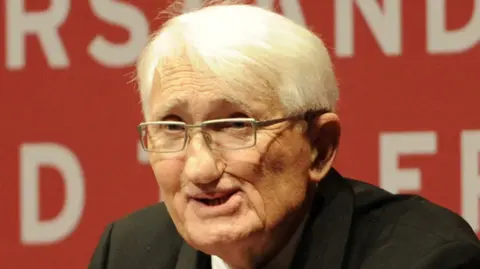 Reuters
Jürgen Habermas pictured at a lecture in 2010
Jürgen Habermas, one of the most influential philosophers and public intellectuals in post-war Germany, has died aged 96.
Habermas, who began teaching philosophy and sociology at the University of Frankfurt in the 1960s, vocally supported the student revolt at West German universities at the time.
He was a leading member of the "Frankfurt School", a body of thought critical of capitalism from a "new left" perspective distinct from traditional Marxism.
He grew up in Nazi Germany and in the 1980s took part in a fierce debate with conservative historians who had questioned whether the Holocaust was a singularly German phenomenon.
Habermas's death was announced on Saturday by his publisher, Suhrkamp.
He was born in Düsseldorf in June 1929. His father, who headed the local chamber of commerce, joined the Nazi Party in 1933.
The young Jürgen was enrolled in the Hitler Youth but was too young to fight in World War Two.
After the war, Habermas studied philosophy and earned a doctorate from Marburg University before joining the University of Frankfurt's Institute of Social Research.
Along with Max Horkheimer and Theodor Adorno, he became a leading exponent of the Frankfurt School.
The school is best known for critical theory – which contends that capitalist society, rather than fostering human emancipation, turns active citizens into passive consumers.
Habermas critiqued what he saw as the commodification of mass media and entertainment, arguing that a mass-produced culture destroys critical public debate.
In 1989-90, he criticised the rapid absorption of East Germany into the West, fearing a revival of nationalism and expressing support for a more gradual process.
In the 1990s, Habermas championed a united Europe, which he regarded as the best defence against the resurgence of nationalist rivalries.
His most influential work, The Theory of Communicative Action, published in 1981, argued that human societies were sustained not by political or economic power but by the capacity for rational dialogue.
Habermas was born with a cleft palate that required repeated operations as a child, an experience he later said helped shape his thinking about language and communication.






 English (US) ·